First Amendment Architecture – Symposium Edition

The Stanford Technology Law Review has published the articles for its 2012 symposium on First Amendment Challenges in the Digital Age. You can read Marvin’s piece, entitled “The Year in ‘First Amendment Architecture'” here.

Below is an excerpt:

The core question we should focus on is whether all Americans have plentiful spaces for speech, access to diverse sources of speech, and the ability to participate in public discourse. This past year, millions of people expressed their political dissent to the powerful in physical and virtual spaces. The question of what kind of democracy we should have—a question asked here and in nations around the world—is a question we do not answer once and for all. We struggle to give answers every day through personal and collective decisions. Determining the scope of our individual free speech rights, and the general  architecture of our free speech system, is fundamental to determining the kind of democracy we are capable of achieving.

Innovation in Lebanon

WSJ’s Tech Europe has a great piece on Startup Weekend – Beirut, which was held in the Lebanese capital this weekend. Startup Weekend events bring together all sorts of people for a weekend to build teams and launch new companies centered around innovative ideas. Before I started delving into the innovation “scene,” I associated startups with tech companies and web apps like Twitter or Instagram, which made people tons of money and led to new features on Facebook or the Google. But the event in Beirut, like others before it, reveals the variety and utility of products and services that these new enterprises can bring to the market:

Among the youngest participants were two 17-year-old high school students from Beirut, Osama Brosh and Omar Turk who created AID (Auditory Impairment Device), a mobile phone application that alerts deaf people to loud sounds—such as fire alarms, car horns or doorbells—through a vibration, winning them first place in the competition.

Brosh and Turk had already chosen the objective of helping deaf individuals, and their winning startup began as a high school science project. The pair is currently working on future products around the same idea.

The Beirut Weekend was one of over a dozen that have occurred in the Middle East since the region’s first event was held in 2010 in Tel Aviv.  You can find out more about Startup Weekend and future events near you at their website, http://startupweekend.org/events/.


Have Fun Storming the Castle! (Europe and ACTA)

On Saturday night, I had a layover of about twelve hours on a trip from Budapest, where I was able to teach in an amazing media policy course at Central European University. That layover was through Charles de Gaulle Airport, in Paris.

Finding myself in Paris, I had the opportunity to go see the Eiffel Tower, the Sacre Coeur Basilica, or the Pont des Arts. But the greatest wonder in Paris is none of those things.

It’s the headquarters of La Quadrature du Net, one of the world’s great organizations working for Internet freedom. I popped over to see Jeremie Zimmermann, the organization’s fearless leader, and to see his team working away into the late evening. On Saturday night, Jeremie and his team were preparing for this week–the week that the European Parliament would vote on ACTA, the controversial copyright/censorship treaty opposed by proponents of an open Internet. We can think of it as the European/international version of SOPA/PIPA, with an increased dose of secrecy.

For those who haven’t followed ACTA closely (most of us Americans), here are some links to read: the Wikipedia entry, Quadrature’s activism, and a page for Europeans to call their representatives

Here is a picture of Jeremie and me. (Yes, that’s a staircase behind the short white wall, and I’m a step or two down). And, yes, those posters all urge you say “No to ACTA”–in different languages.

Image

Jeremie and many others were heading to Strasbourg for the vote

As I bid adieu to Jeremie, I was reminded of this scene in The Princess Bride (minus the miracle): “Have fun storming the castle!” Good luck slaying ACTA, and burying it for good. 

Citizens United Redux: or What “Democracy” Means for our Five Republican-Appointed Justices

People are discussing the Arizona immigration ruling and, once again, Citizens United and its effect on our democracy.

Today, without oral argument or briefing, the Supreme Court handed down American Tradition Partnership v. Bullock, a one-page decision  reversing the Montana Supreme Court and striking down a 100 year old law limiting corporate spending in Montana elections. The Court–or rather the same five Justices appointed by Republicans who brought us Citizens United–held that Citizens United squarely forbids states from banning corporate spending on elections–whatever the facts in that state. The dissenters–or the four Justices appointed by Democrats–would have heard the case to reconsider Citizens United, noting that expenditures can be as corrupting as direct contributions, and noting the huge flood of corrupting corporate money in the 2012 elections.

This decision may show that the Supreme Court will not defer to the fact-finding of legislatures. The Court is instead determining its own facts. Those facts: no, no, expenditures do not give rise to corruption or its appearance. The first fact is about how elected officials react to expenditures. The second fact is about how Americans view the millions spent by SuperPACs and huge corporations. The Supreme Court’s view on both of these facts is probably totally detached from the experience of elected officials and average Americans, many of whom think their government is corrupt.

But that can’t be right. The Montana decision goes into great detail about how out of state corporations and “copper kings” would buy and sell the government through expenditures. Those facts were swept aside in a page. (You should read for the riveting, corrupt soap-opera-like drama alone (e.g., pages 14-25).)

Instead, what’s going on is something different.

Either (1) the five Republican-appointed Justices are completely unprincipled and simply will do whatever it takes to help Republicans gain power and enact a pro-corporate agenda. In a widely read Atlantic piece, James Fallows just accused the five Justices–Kennedy, Scalia, Thomas, Roberts, and Alito–of being part of a judicial “coup” running back to Bush v. Gore, which included three of these justices and two replaced by Roberts and Alito.

Or, to be more charitable, the Supreme Court might actually have a principle.  The Supreme Court (2) might not care about the facts (as it doesn’t) because it simply believes that corporations should be part of our democracy. They should be able, as a matter of right, to buy and sell candidates who agree and disagree with them, just as individuals should be allowed to vote for or against candidates. They don’t think there’s anything wrong with corporate involvement in campaigns. Justices on the infamous Lochner court probably didn’t second-guess the health conclusions of the laws; they believed the laws conflicted with liberty.

From both Citizens United and this decision, it seems our Republican-appointed five man majority defines liberty and democracy to require unlimited corporate spending on elections–whatever the facts, whatever the outcomes (though knowing those outcomes favor Republicans and favor donors who fly Justices to nice events and fund their wives’ organizations).

This decision raises one other point: many hopeful activists have proposed ways around Citizens United they think would be upheld. That is probably nuts. The five-member majority will not let that happen. If a state Supreme Court, upholding its own legislature, on a hundred year law, on a colorful and deep record, to keep out the corruption of out-of-state corporations, is struck down without ceremony, I can’t see many laws getting through these guys.

The Court has even undermined public financing and public matching funds more than most people will admit. If a state makes public financing available for one side, the state could not increase the amount provided or the matching funds formula based on the money spent by the other side or the supporters of the other side. These limits constrain the effectiveness of public funding; indeed, they effectively make it impossible to match the resources of those backed by billionaires willing to write huge checks.

I have written elsewhere that I think Obama should make the Supreme Court–and particularly Citizens United–a key plank in his campaign. If the public knew more about the five Republican appointees to the Supreme Court–e.g., that their current Chief isn’t Thurgood Marshall and Harry Reid–maybe they would be more excited about voting for Obama and for Senate Democratic candidates, and against their opponents.

(Cross-posted at Balkinization.)

Marvin Speaking at Networked Nation

Marvin will be speaking this morning at the National Press Club for Networked Nation, an event jointly sponsored by National Journal and The Atlantic, with the support AllState. Networked Nation examines the new dynamic of communication between business and their customers through social media tools, and how that evolving relationship affects the economy at large. Marvin’s remarks will focus on the importance of an open Internet for promoting and preserving unrestricted speech in this area, and why it is in the interest of companies to promote open Internet policies.

Other speakers include Scott Monty, Global Head of Social Media of Ford Motor Company, Edward Reilly, CEO of FD Americas, and Matthew Slutsky, Director of Partnerships of Change.org.

“Search Neutrality” and Network Neutrality: Birds of a Very Different Feather

The Antitrust & Competition Law Blog is hosting a blog symposium on search/social media and antitrust, following up a conference at George Mason last week.  My friend Frank Pasquale, a professor at Seton Hall, wrote a blog post suggesting that my position on “search neutrality” (opposition) is in tension with my position on network neutrality (support).

I wrote a post on the differences between the two that I hope will persuade him.

The post includes definitions and detailed discussion. But I note that far fewer advocates support search neutrality than network neutrality and I think it’s because of the distinctions I set out.

The post ends with this section on how “search neutrality” and network neutrality have different supporters.

***

Different Supporters and Opponents.

The godfather of “search neutrality” is Frank Pasquale, a beloved, polymathic law professor at Seton Hall (and a friend), who often steps into the lion’s den with antitrust economists to argue for broader conceptions of the good than mere, American-centered efficiency.  He co-authored perhaps the leading article on search neutrality, a follow-up arguing for a government-funded search engine that might obviate the need for search neutrality, and has increasingly staked out a position focused on transparency arguments and disclosure rather than conduct. Opponents of search neutrality include Law School professor James Grimmelmann and Santa Clara Law School professor Eric Goldman who have argued, among other things, that “search neutrality” is incoherent, undefined, and self-contradicting. I don’t know for sure, but I am guessing all three support some version of network neutrality.

At the same time, no nonprofit advocacy organization that fought for network neutrality has spoken out in favor of “search neutrality,” to my knowledge. I am not sure which consumer groups, if any, advocate for search neutrality today. The “advocates” for search neutrality in Washington, DC, have at times seemed purely strategic and half-hearted. In the FCC’s network-neutrality proceeding, cable and phone companies that oppose network neutrality, such as AT&T and Time Warner Cable, cynically invoked “search neutrality” as a bogeyman to distract from the core debates in those proceedings. (See filings here, here, and here for examples.) Today, the leading corporate advocates for “search neutrality” understandably are a coalition of companies, called “FairSearch,” that see themselves as competing with Google are arguing for a “search neutrality” requirement to be imposed on Google. More specialized search companies in that coalition, such as Yelp, MapQuest, TripAdvisor, and Foundem (a product search site or, depending on your viewpoint, a spammy mirror site), have alleged discrimination either by reducing the ranking of the site or elevating the ranking of Google search products. The coalition also includes Microsoft, which owns rival search engine Bing, and is not necessarily alleging search discrimination against its own Bing products in Google Search. Moreover, studies suggest that Microsoft’s Bing and Google’s search both return their own affiliated sites with similar prominence within search results. So Microsoft’s argument on “search neutrality,” like those of cable and phone companies, comes off as somewhat more strategic than principled—since Bing does not profess to offer “neutrality” vis a vis specialized search providers.

***

In the blog post, I also explain the key economic and conceptual differences between the two. After the flip, I include those distinctions and the rest of the post.

Continue reading

Some Further Thoughts on Google Antitrust Remedies (FairSearch/EU)

Last week, at a conference at George Mason, I presented a paper on the remedies proposed by Google’s competitors in the antitrust inquiries in the US and EU. Yesterday, the European antitrust chief Joaquin  Almunia pinpointed four specific areas of concern for Google.

But he did not propose any remedies, asking Google to do it.

Google supported the paper that I wrote with Luke Pelican, but we wrote it because the remedies proposed by competitors have been so evidently problematic– bad for consumer welfare, competition, and innovation online, even if they would be good for Google’s competitors in a coalition called FairSearch (Microsoft, Yelp, Mapquest). Two remedies in particular–those regarding search neutrality and “copying”–struck me as most problematic perhaps, and are covered in sections #2 and #5 of our paper. (Beyond our paper, James Grimmelmann has written the classic article criticizing search neutrality and I wrote a blog post about the problems with the “copying” claim.)

The day of the conference, the main coalition of companies opposed to Google and pushing the antitrust case–FairSearch– issued a blog post accusing me of (1) claiming Google was above the law, (2) of (maybe?) admitting that Google “discriminates,” and (3) suggesting that the paper contradicts something I wrote in favor of specific government regulation of discrimination in a different market based on a different record and different economic and non-economic consequences.

I welcome a real response to the arguments made in our paper–and I expect to see a response eventually. But I’ll respond to these right now.

First, Luke and I do not claim Google is above the law–just that Google’s competitors have proposed remedies that have little basis in law and that would harm competition, consumer welfare, and innovation. Google also doesn’t claim it’s above the law–just that it has not broken the law.

Second, FairSearch’s post suggests that Google admitted to “discrimination.” I am not sure if that’s not a reference to our paper. In our paper, merely for the sake of argument we set aside Google’s competitors’ factual assertions in order to focus on evaluating the remedies. That focus on remedies obviously doesn’t concede anything on substance–just as a “motion to dismiss” certain damages claims in court assumes (for the sake of argument) but does not admit to the conduct at issue. But we don’t think really think search discrimination is a coherent concept (being persuaded by Grimmelmann‘s work) so we wouldn’t really “admit” that (or “deny” that) on behalf of anyone.

Third, there is nothing inconsistent about supporting a regulatory intervention in one market (network infrastructure) but not another, based on market characteristics. If the coffee lobby argues for “neutrality” among coffee beans at my favorite coffee shop in DC (Yola on Connecticut), my understanding of the economics of coffee and coffee shops in this market would lead me to oppose, not favor, the imposition of (not yet defined) “coffee neutrality” rules on coffee shops like Yola that use exceptional beans. The whole point of policy analysis is to determine when and how government should be involved in particular markets–by supporting or opposing a particular government intervention in one market you are not signing up to support all government intervention (or non-intervention) in every market.

I wrote a blog post today detailing the many differences between search neutrality and network neutrality, partly because I think my friend Frank Pasquale at Seton Hall Law School is mistaken about their similarities and I’d like to persuade him otherwise.

In light of the discussion of remedies, it’d be helpful to include a list of many remedies that have been proposed by Google’s competitors, which we place in five categories. The weaknesses of most of them are readily apparent:

  1. “search neutrality” re specific links: or a ban on Google disadvantaging the links of sites that compete with it (even though “search neutrality” is an incoherent concept that no technical committee or analogy makes administrable by a court or agency);
  2. “search neutrality” re specialized search competitors: a ban on Google showing Google Maps, News, or Places in a search result, and forcing Google to let users choose MapQuest, news sites, or Yelp for the search returns–or break up the company by splitting off Maps, News, and Places (even though the remedy would not benefit consumers and would retard and reverse innovation);
  3. a ban on Google’s “deception” by requiring Google to reveal its economic interest in links, deviations from “natural search algorithms,” algorithm updates, and advertising rates (while this set of remedies is the leas problematic,  Google does provide plenty of information and argues that providing more information would merely help spammers and competitors–and a standalone deception or fraud claim would be available if Google is being deceptive);
  4. a requirement that Google get permission to display snippets of text from some companies (even though displaying the snippets does not violate copyright and aligns with the fair use exception required under the Constitution) and a requirement that Google share its own content such as YouTube (even though Google already shares this content, companies like Facebook do not share much of their content within their rights, and forcing Google to share other content would simply enable an equally large Microsoft to free ride off of Google’s investment); and
  5. limits on Google’s ability to acquire companies or enter into exclusive deals for search on the iPhone, Mozilla Firefox, and elsewhere (even though all of Google’s largest competitors acquire small innovative companies to compete dynamically and excluding Google from these exclusive partnerships would merely lower the price Microsoft would pay for them).

These proposed remedies are weak, in my opinion, and most of them are weak on their face. Their weakness probably explains why Google’s competitors have listed so many remedies in a shotgun fashion, but have not provided much detail on how to implement them. The weakness of competitors’ proposed remedies probably also explains why the EU did not even propose remedies.

Medal Ceremony in Real Life: for Internet Awesomeness

When I was quite young, I saw the first Star Wars movie and believed that, if I took part in a great cause, it would end with a medal ceremony and a princess conferring the medal.

It has finally happened.

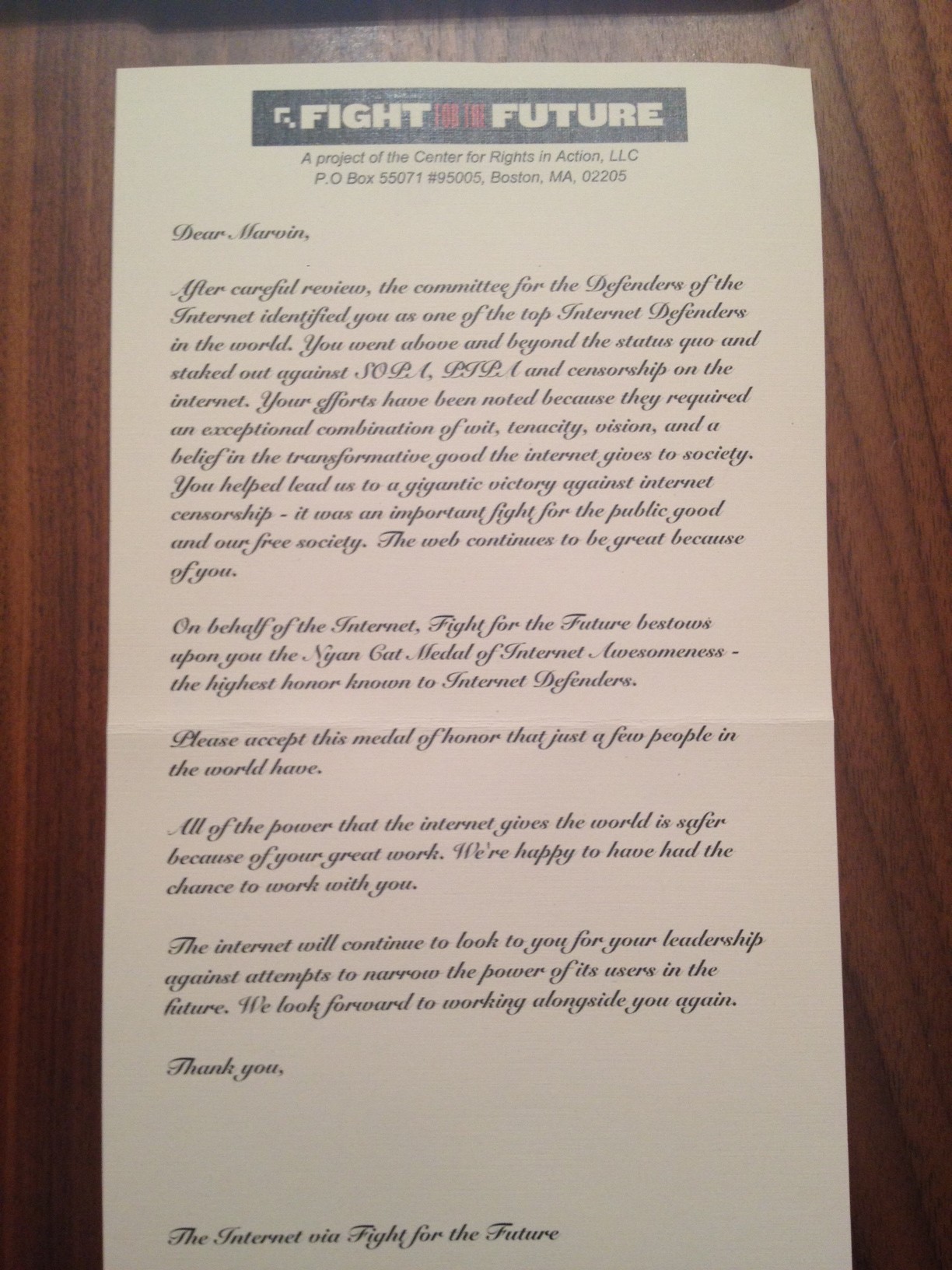
Last night, I received a medal from Princess Tiffiniy Ying Cheng of Fight for the Future, representing the “committee for the Defenders of the Internet.” Bestowed upon me was the Nyan Cat Medal of Internet Awesomeness, the “highest honor known to Internet Defenders.” I could not be more honored.

Princess Tiffiniy’s organization was one of the leaders in the Battle of SOPA.  She and her partner Holmes Wilson are pretty amazingly brilliant–they were the people who organized the Free Justin Bieber campaign, led American Censorship Day on November 16, and were among the leaders organizing the January 18 Blackout. Many people pulled together from an array of communities to fight SOPA–Redditers, Wikipedians, civil libertarians, entrepreneurs, artists, venture capitalists, tech executives, consumer electronics makers, tech bloggers–alongside millions of people who just love the Internet and hate Internet censorship, from technologically advanced Wookiies to technologically challenged Ewoks. Many awesome people were involved in leading, coordinating, and taking the time to fight SOPA. Fight for the Future was absolutely essential to catalyzing all that activism–all while Holmes lived in an undisclosed location on an island and Tiffiniy lived on an apple orchard in rural Massachusetts with a spotty Internet signal.

I thank the princess and the entire committee for the Defenders of the Internet, not just for the medal but for their leadership in defending the open Internet.

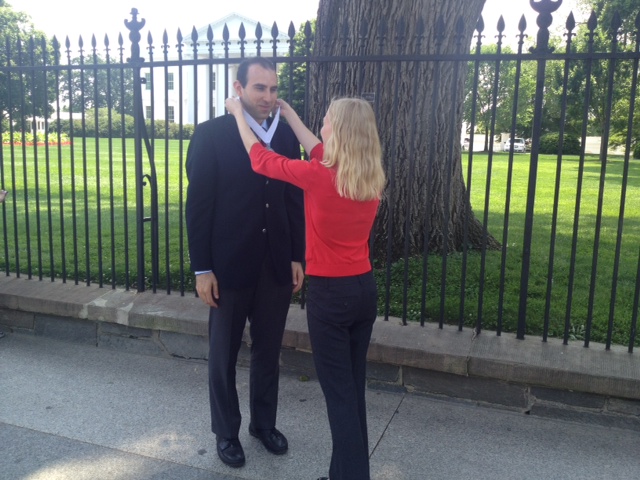
I am also including a picture of the letter accompanying the medal, a picture of me going to sleep with the medal because I love it so much, and a picture of me at the medal ceremony.

Letter:

Proof that I sleep with the medal already:

I know. You may wonder: “Do you always sleep on your couch, while clutching a book written by Larry Lessig, wearing a tie and jacket just in case the Internet Defenders send out the Internet Bat Signal and call on you in the middle of the night to fight disastrous Internet legislation with a medal around your neck?”

Yeah. That’s right.

Keep in mind: it’s only Alexis Ohanian who doesn’t need to sleep at all and only Mike Masnick who doesn’t sleep under a blanket but sleeps while standing up–on a treadmill desk while jogging and writing blog posts.

Medal Ceremony:

Because Princess Tiffiniy lives on an apple orchard far from DC, I had to ask another princess I know to stand in and to confer the medal on me, during her lunch break, beneath an oak tree. We found one near the White House.

UPDATE: Thanks Xeni/BoingBoing for the story and the link to the Fast Company props! Obviously, I love BoingBoing.

UPDATE 2: Here is a picture of Tiffiniy herself conferring the medal on Mike Masnick.

Fast Company’s 100 Most Creative People In Business: Marvin Ammori

Each year, the magazine Fast Company issues a list of its 100 Most Creative People In Business, an “annual celebration of business innovators who dare to think differently.” This year they’ve named Marvin as one of those innovators, for his work in raising important First Amendment concerns over copyright legislation earlier this year. Those who’ve worked with him know how creative and effective he is, though he’d be the first to say he is simply one of millions of people and dozens of leaders responsible for changing the debate on SOPA and PIPA in Washington and across the country.

Congratulations to him and to all who led the way in battling for a free and open Internet against flawed legislative proposals that threatened it.

Remedies Proposed in the Google Antitrust Inquiry: New Paper

On Wednesday, May 16, I will be speaking at an academic conference on competition, search, and social media. The list of speakers is impressive and it promises to be a great conference. I will speak on the panel regarding remedies.

In anticipation of the conference, many speakers wrote papers on the subjects of antitrust, search, and social media. With my former student (and now colleague) Luke Pelican, I wrote an article analyzing the many remedies proposed by companies that have sought antitrust inquiries of Google’s practices. Because these competitors have proposed over a dozen remedies, we had to categorize the remedies in five general categories and evaluate them all. It’s not light reading, but we hope it contributes to the debate.

Here is a link to a PDF of the article.

Here is a paragraph from the article that conveys our top-level conclusion:

This article concludes that the cures proposed by the competitors are worse than Google’s alleged disease. The proposed remedies might benefit the short-term economic interests of Google’s competitors that are members of FairSearch and ICOMP, but benefiting competitors is not the goal of antitrust law. The goal of antitrust law is to promote consumer welfare, competition, and innovation. The proposed remedies, however, would do the opposite: harm consumers, impede competition, and stifle innovation. The remedies would invite government agencies and technical committees to second-guess and evaluate both mundane and game-changing engineering and user-interface decisions regarding Google Search, reverse long-standing fair use principles rooted in constitutional requirements, and empower competitors to litigate rather than compete against daily innovations and disclosures by Google.

We discussed one of the proposed remedies, regarding copyright, a few days ago on this blog.

The article is to be published today by the Journal of Internet Law. Google funded our work on the paper, though the paper does not necessarily reflect Google’s position. That company is a client of our firm on a range of issues.

It’s also an honor (and, for us, fun) to participate in these crucial debates alongside such great thinkers. A few months ago, I released a First Amendment analysis of SOPA and PIPA alongside a parallel analysis by Harvard professor Laurence Tribe, he on behalf of the Consumer Electronics Association and I for Google. Today, our article follows on the heels of a paper by UCLA professor Eugene Volokh (I would dissent from part of his analysis), both of which were funded by Google. Even though Google has the most interest in these issues today, the precedents we set today will influence the competitive landscape for years to come.