Author Archives: Marvin Ammori

Citizens United Redux: or What “Democracy” Means for our Five Republican-Appointed Justices

People are discussing the Arizona immigration ruling and, once again, Citizens United and its effect on our democracy.

Today, without oral argument or briefing, the Supreme Court handed down American Tradition Partnership v. Bullock, a one-page decision  reversing the Montana Supreme Court and striking down a 100 year old law limiting corporate spending in Montana elections. The Court–or rather the same five Justices appointed by Republicans who brought us Citizens United–held that Citizens United squarely forbids states from banning corporate spending on elections–whatever the facts in that state. The dissenters–or the four Justices appointed by Democrats–would have heard the case to reconsider Citizens United, noting that expenditures can be as corrupting as direct contributions, and noting the huge flood of corrupting corporate money in the 2012 elections.

This decision may show that the Supreme Court will not defer to the fact-finding of legislatures. The Court is instead determining its own facts. Those facts: no, no, expenditures do not give rise to corruption or its appearance. The first fact is about how elected officials react to expenditures. The second fact is about how Americans view the millions spent by SuperPACs and huge corporations. The Supreme Court’s view on both of these facts is probably totally detached from the experience of elected officials and average Americans, many of whom think their government is corrupt.

But that can’t be right. The Montana decision goes into great detail about how out of state corporations and “copper kings” would buy and sell the government through expenditures. Those facts were swept aside in a page. (You should read for the riveting, corrupt soap-opera-like drama alone (e.g., pages 14-25).)

Instead, what’s going on is something different.

Either (1) the five Republican-appointed Justices are completely unprincipled and simply will do whatever it takes to help Republicans gain power and enact a pro-corporate agenda. In a widely read Atlantic piece, James Fallows just accused the five Justices–Kennedy, Scalia, Thomas, Roberts, and Alito–of being part of a judicial “coup” running back to Bush v. Gore, which included three of these justices and two replaced by Roberts and Alito.

Or, to be more charitable, the Supreme Court might actually have a principle.  The Supreme Court (2) might not care about the facts (as it doesn’t) because it simply believes that corporations should be part of our democracy. They should be able, as a matter of right, to buy and sell candidates who agree and disagree with them, just as individuals should be allowed to vote for or against candidates. They don’t think there’s anything wrong with corporate involvement in campaigns. Justices on the infamous Lochner court probably didn’t second-guess the health conclusions of the laws; they believed the laws conflicted with liberty.

From both Citizens United and this decision, it seems our Republican-appointed five man majority defines liberty and democracy to require unlimited corporate spending on elections–whatever the facts, whatever the outcomes (though knowing those outcomes favor Republicans and favor donors who fly Justices to nice events and fund their wives’ organizations).

This decision raises one other point: many hopeful activists have proposed ways around Citizens United they think would be upheld. That is probably nuts. The five-member majority will not let that happen. If a state Supreme Court, upholding its own legislature, on a hundred year law, on a colorful and deep record, to keep out the corruption of out-of-state corporations, is struck down without ceremony, I can’t see many laws getting through these guys.

The Court has even undermined public financing and public matching funds more than most people will admit. If a state makes public financing available for one side, the state could not increase the amount provided or the matching funds formula based on the money spent by the other side or the supporters of the other side. These limits constrain the effectiveness of public funding; indeed, they effectively make it impossible to match the resources of those backed by billionaires willing to write huge checks.

I have written elsewhere that I think Obama should make the Supreme Court–and particularly Citizens United–a key plank in his campaign. If the public knew more about the five Republican appointees to the Supreme Court–e.g., that their current Chief isn’t Thurgood Marshall and Harry Reid–maybe they would be more excited about voting for Obama and for Senate Democratic candidates, and against their opponents.

(Cross-posted at Balkinization.)

“Search Neutrality” and Network Neutrality: Birds of a Very Different Feather

The Antitrust & Competition Law Blog is hosting a blog symposium on search/social media and antitrust, following up a conference at George Mason last week.  My friend Frank Pasquale, a professor at Seton Hall, wrote a blog post suggesting that my position on “search neutrality” (opposition) is in tension with my position on network neutrality (support).

I wrote a post on the differences between the two that I hope will persuade him.

The post includes definitions and detailed discussion. But I note that far fewer advocates support search neutrality than network neutrality and I think it’s because of the distinctions I set out.

The post ends with this section on how “search neutrality” and network neutrality have different supporters.

***

Different Supporters and Opponents.

The godfather of “search neutrality” is Frank Pasquale, a beloved, polymathic law professor at Seton Hall (and a friend), who often steps into the lion’s den with antitrust economists to argue for broader conceptions of the good than mere, American-centered efficiency.  He co-authored perhaps the leading article on search neutrality, a follow-up arguing for a government-funded search engine that might obviate the need for search neutrality, and has increasingly staked out a position focused on transparency arguments and disclosure rather than conduct. Opponents of search neutrality include Law School professor James Grimmelmann and Santa Clara Law School professor Eric Goldman who have argued, among other things, that “search neutrality” is incoherent, undefined, and self-contradicting. I don’t know for sure, but I am guessing all three support some version of network neutrality.

At the same time, no nonprofit advocacy organization that fought for network neutrality has spoken out in favor of “search neutrality,” to my knowledge. I am not sure which consumer groups, if any, advocate for search neutrality today. The “advocates” for search neutrality in Washington, DC, have at times seemed purely strategic and half-hearted. In the FCC’s network-neutrality proceeding, cable and phone companies that oppose network neutrality, such as AT&T and Time Warner Cable, cynically invoked “search neutrality” as a bogeyman to distract from the core debates in those proceedings. (See filings here, here, and here for examples.) Today, the leading corporate advocates for “search neutrality” understandably are a coalition of companies, called “FairSearch,” that see themselves as competing with Google are arguing for a “search neutrality” requirement to be imposed on Google. More specialized search companies in that coalition, such as Yelp, MapQuest, TripAdvisor, and Foundem (a product search site or, depending on your viewpoint, a spammy mirror site), have alleged discrimination either by reducing the ranking of the site or elevating the ranking of Google search products. The coalition also includes Microsoft, which owns rival search engine Bing, and is not necessarily alleging search discrimination against its own Bing products in Google Search. Moreover, studies suggest that Microsoft’s Bing and Google’s search both return their own affiliated sites with similar prominence within search results. So Microsoft’s argument on “search neutrality,” like those of cable and phone companies, comes off as somewhat more strategic than principled—since Bing does not profess to offer “neutrality” vis a vis specialized search providers.

***

In the blog post, I also explain the key economic and conceptual differences between the two. After the flip, I include those distinctions and the rest of the post.

Continue reading

Some Further Thoughts on Google Antitrust Remedies (FairSearch/EU)

Last week, at a conference at George Mason, I presented a paper on the remedies proposed by Google’s competitors in the antitrust inquiries in the US and EU. Yesterday, the European antitrust chief Joaquin  Almunia pinpointed four specific areas of concern for Google.

But he did not propose any remedies, asking Google to do it.

Google supported the paper that I wrote with Luke Pelican, but we wrote it because the remedies proposed by competitors have been so evidently problematic– bad for consumer welfare, competition, and innovation online, even if they would be good for Google’s competitors in a coalition called FairSearch (Microsoft, Yelp, Mapquest). Two remedies in particular–those regarding search neutrality and “copying”–struck me as most problematic perhaps, and are covered in sections #2 and #5 of our paper. (Beyond our paper, James Grimmelmann has written the classic article criticizing search neutrality and I wrote a blog post about the problems with the “copying” claim.)

The day of the conference, the main coalition of companies opposed to Google and pushing the antitrust case–FairSearch– issued a blog post accusing me of (1) claiming Google was above the law, (2) of (maybe?) admitting that Google “discriminates,” and (3) suggesting that the paper contradicts something I wrote in favor of specific government regulation of discrimination in a different market based on a different record and different economic and non-economic consequences.

I welcome a real response to the arguments made in our paper–and I expect to see a response eventually. But I’ll respond to these right now.

First, Luke and I do not claim Google is above the law–just that Google’s competitors have proposed remedies that have little basis in law and that would harm competition, consumer welfare, and innovation. Google also doesn’t claim it’s above the law–just that it has not broken the law.

Second, FairSearch’s post suggests that Google admitted to “discrimination.” I am not sure if that’s not a reference to our paper. In our paper, merely for the sake of argument we set aside Google’s competitors’ factual assertions in order to focus on evaluating the remedies. That focus on remedies obviously doesn’t concede anything on substance–just as a “motion to dismiss” certain damages claims in court assumes (for the sake of argument) but does not admit to the conduct at issue. But we don’t think really think search discrimination is a coherent concept (being persuaded by Grimmelmann‘s work) so we wouldn’t really “admit” that (or “deny” that) on behalf of anyone.

Third, there is nothing inconsistent about supporting a regulatory intervention in one market (network infrastructure) but not another, based on market characteristics. If the coffee lobby argues for “neutrality” among coffee beans at my favorite coffee shop in DC (Yola on Connecticut), my understanding of the economics of coffee and coffee shops in this market would lead me to oppose, not favor, the imposition of (not yet defined) “coffee neutrality” rules on coffee shops like Yola that use exceptional beans. The whole point of policy analysis is to determine when and how government should be involved in particular markets–by supporting or opposing a particular government intervention in one market you are not signing up to support all government intervention (or non-intervention) in every market.

I wrote a blog post today detailing the many differences between search neutrality and network neutrality, partly because I think my friend Frank Pasquale at Seton Hall Law School is mistaken about their similarities and I’d like to persuade him otherwise.

In light of the discussion of remedies, it’d be helpful to include a list of many remedies that have been proposed by Google’s competitors, which we place in five categories. The weaknesses of most of them are readily apparent:

  1. “search neutrality” re specific links: or a ban on Google disadvantaging the links of sites that compete with it (even though “search neutrality” is an incoherent concept that no technical committee or analogy makes administrable by a court or agency);
  2. “search neutrality” re specialized search competitors: a ban on Google showing Google Maps, News, or Places in a search result, and forcing Google to let users choose MapQuest, news sites, or Yelp for the search returns–or break up the company by splitting off Maps, News, and Places (even though the remedy would not benefit consumers and would retard and reverse innovation);
  3. a ban on Google’s “deception” by requiring Google to reveal its economic interest in links, deviations from “natural search algorithms,” algorithm updates, and advertising rates (while this set of remedies is the leas problematic,  Google does provide plenty of information and argues that providing more information would merely help spammers and competitors–and a standalone deception or fraud claim would be available if Google is being deceptive);
  4. a requirement that Google get permission to display snippets of text from some companies (even though displaying the snippets does not violate copyright and aligns with the fair use exception required under the Constitution) and a requirement that Google share its own content such as YouTube (even though Google already shares this content, companies like Facebook do not share much of their content within their rights, and forcing Google to share other content would simply enable an equally large Microsoft to free ride off of Google’s investment); and
  5. limits on Google’s ability to acquire companies or enter into exclusive deals for search on the iPhone, Mozilla Firefox, and elsewhere (even though all of Google’s largest competitors acquire small innovative companies to compete dynamically and excluding Google from these exclusive partnerships would merely lower the price Microsoft would pay for them).

These proposed remedies are weak, in my opinion, and most of them are weak on their face. Their weakness probably explains why Google’s competitors have listed so many remedies in a shotgun fashion, but have not provided much detail on how to implement them. The weakness of competitors’ proposed remedies probably also explains why the EU did not even propose remedies.

Medal Ceremony in Real Life: for Internet Awesomeness

When I was quite young, I saw the first Star Wars movie and believed that, if I took part in a great cause, it would end with a medal ceremony and a princess conferring the medal.

It has finally happened.

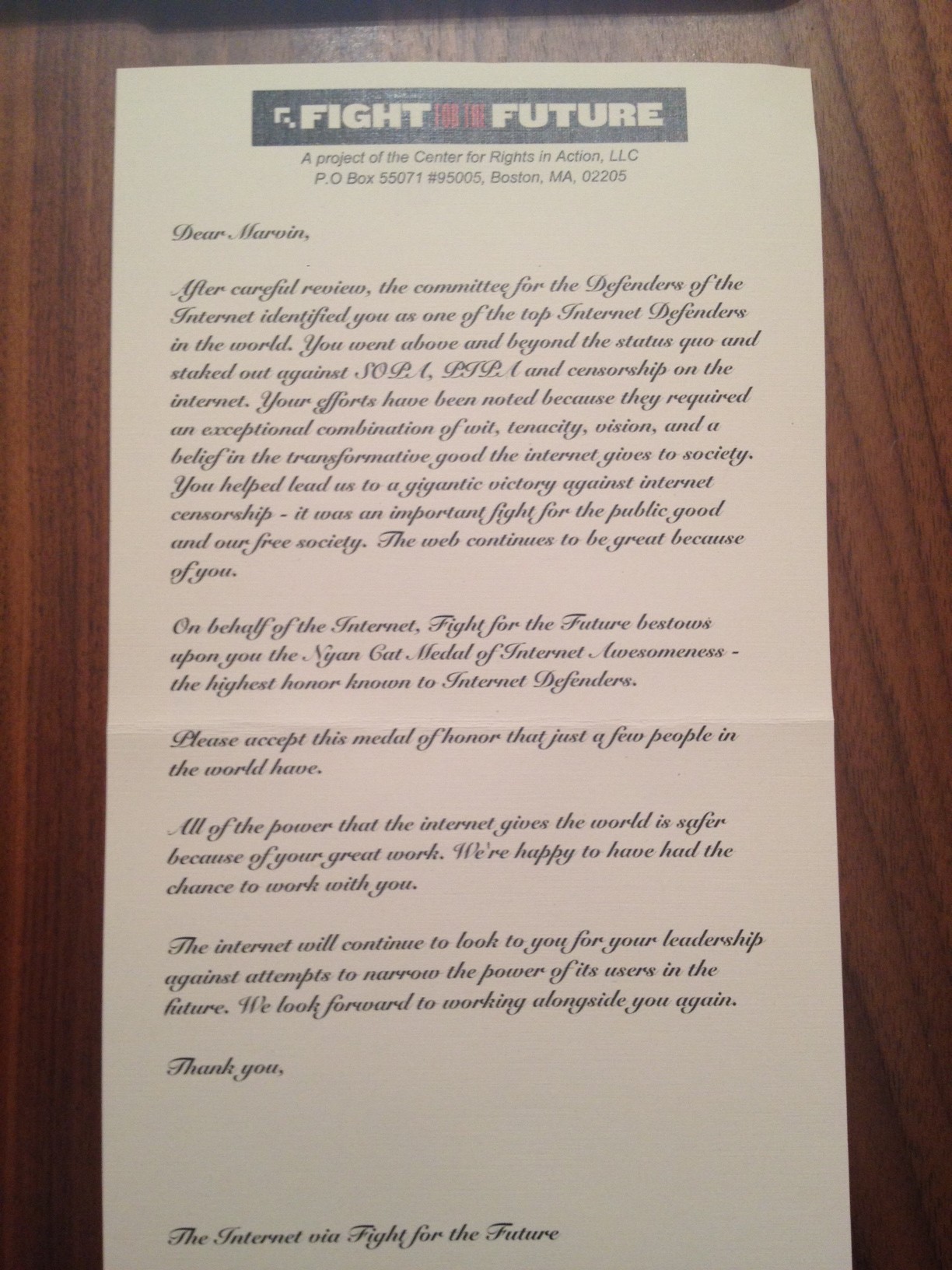
Last night, I received a medal from Princess Tiffiniy Ying Cheng of Fight for the Future, representing the “committee for the Defenders of the Internet.” Bestowed upon me was the Nyan Cat Medal of Internet Awesomeness, the “highest honor known to Internet Defenders.” I could not be more honored.

Princess Tiffiniy’s organization was one of the leaders in the Battle of SOPA.  She and her partner Holmes Wilson are pretty amazingly brilliant–they were the people who organized the Free Justin Bieber campaign, led American Censorship Day on November 16, and were among the leaders organizing the January 18 Blackout. Many people pulled together from an array of communities to fight SOPA–Redditers, Wikipedians, civil libertarians, entrepreneurs, artists, venture capitalists, tech executives, consumer electronics makers, tech bloggers–alongside millions of people who just love the Internet and hate Internet censorship, from technologically advanced Wookiies to technologically challenged Ewoks. Many awesome people were involved in leading, coordinating, and taking the time to fight SOPA. Fight for the Future was absolutely essential to catalyzing all that activism–all while Holmes lived in an undisclosed location on an island and Tiffiniy lived on an apple orchard in rural Massachusetts with a spotty Internet signal.

I thank the princess and the entire committee for the Defenders of the Internet, not just for the medal but for their leadership in defending the open Internet.

I am also including a picture of the letter accompanying the medal, a picture of me going to sleep with the medal because I love it so much, and a picture of me at the medal ceremony.

Letter:

Proof that I sleep with the medal already:

I know. You may wonder: “Do you always sleep on your couch, while clutching a book written by Larry Lessig, wearing a tie and jacket just in case the Internet Defenders send out the Internet Bat Signal and call on you in the middle of the night to fight disastrous Internet legislation with a medal around your neck?”

Yeah. That’s right.

Keep in mind: it’s only Alexis Ohanian who doesn’t need to sleep at all and only Mike Masnick who doesn’t sleep under a blanket but sleeps while standing up–on a treadmill desk while jogging and writing blog posts.

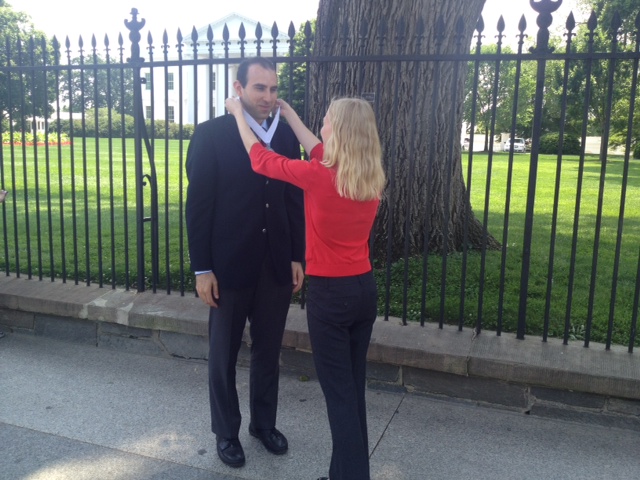
Medal Ceremony:

Because Princess Tiffiniy lives on an apple orchard far from DC, I had to ask another princess I know to stand in and to confer the medal on me, during her lunch break, beneath an oak tree. We found one near the White House.

UPDATE: Thanks Xeni/BoingBoing for the story and the link to the Fast Company props! Obviously, I love BoingBoing.

UPDATE 2: Here is a picture of Tiffiniy herself conferring the medal on Mike Masnick.

Remedies Proposed in the Google Antitrust Inquiry: New Paper

On Wednesday, May 16, I will be speaking at an academic conference on competition, search, and social media. The list of speakers is impressive and it promises to be a great conference. I will speak on the panel regarding remedies.

In anticipation of the conference, many speakers wrote papers on the subjects of antitrust, search, and social media. With my former student (and now colleague) Luke Pelican, I wrote an article analyzing the many remedies proposed by companies that have sought antitrust inquiries of Google’s practices. Because these competitors have proposed over a dozen remedies, we had to categorize the remedies in five general categories and evaluate them all. It’s not light reading, but we hope it contributes to the debate.

Here is a link to a PDF of the article.

Here is a paragraph from the article that conveys our top-level conclusion:

This article concludes that the cures proposed by the competitors are worse than Google’s alleged disease. The proposed remedies might benefit the short-term economic interests of Google’s competitors that are members of FairSearch and ICOMP, but benefiting competitors is not the goal of antitrust law. The goal of antitrust law is to promote consumer welfare, competition, and innovation. The proposed remedies, however, would do the opposite: harm consumers, impede competition, and stifle innovation. The remedies would invite government agencies and technical committees to second-guess and evaluate both mundane and game-changing engineering and user-interface decisions regarding Google Search, reverse long-standing fair use principles rooted in constitutional requirements, and empower competitors to litigate rather than compete against daily innovations and disclosures by Google.

We discussed one of the proposed remedies, regarding copyright, a few days ago on this blog.

The article is to be published today by the Journal of Internet Law. Google funded our work on the paper, though the paper does not necessarily reflect Google’s position. That company is a client of our firm on a range of issues.

It’s also an honor (and, for us, fun) to participate in these crucial debates alongside such great thinkers. A few months ago, I released a First Amendment analysis of SOPA and PIPA alongside a parallel analysis by Harvard professor Laurence Tribe, he on behalf of the Consumer Electronics Association and I for Google. Today, our article follows on the heels of a paper by UCLA professor Eugene Volokh (I would dissent from part of his analysis), both of which were funded by Google. Even though Google has the most interest in these issues today, the precedents we set today will influence the competitive landscape for years to come.

Volokh’s First Amendment Analysis re Google Search: Dissenting in part, Concurring in Part

Next Wednesday, May 16, George Mason University is hosting an academic conference on competition, search, and social media. Most academic conferences are not newsworthy. (They’re often boring.) But the Wall Street Journal has already written about two papers sponsored by Google, one of which will be presented at this conference. The Journal describes the two papers as evidence that one of the world’s largest companies (Google) is “returning fire” against a federal agency (the Federal Trade Commission).

This is already the most exciting academic conference ever.

As someone who’ll be speaking at the conference, I’d hate to burst the bubble… but there have been dozens of geeky conferences and panels by academic institutions and think tanks about the question of antitrust and Google. The conferences are trying to shed light on some hard and interesting questions ranging from the role of antitrust in dynamic industries to appropriate remedies to search results and free speech. (And if you’re going to have a conference, why discuss antitrust in corrugated steel or cardboard box inputs?)

Some of the papers presented at these conferences are funded by Google, some by its competitors, and some are written by academics funded by neither. Authors include economists, law professors, technologists, and lawyers.

I am speaking on the last panel, about remedies. My own paper for the conference will be published in the Journal of Internet Law on Monday. My paper focuses on the remedies proposed by Google’s competitors in the antitrust inquiry. It provides a detailed legal analysis of the dozen or so proposed remedies, which range from the “completely ridiculous” to the “apparently plausible but do not hold up under close scrutiny.” My paper, like Volokh’s, was supported by Google, which is a client of my law firm. (And to clarify–I don’t speak for Google, but I do hope that some of their lawyers read my paper, learn something from it, and perhaps even adopt the arguments presented in the paper ….)

UCLA law professor Eugene Volokh will be on the remedies panel as well. Volokh is a famous First Amendment scholar (though he has made contributions in other fields) and he runs a popular legal blog called the Volokh Conspiracy. He has a libertarian bent. If he ended up on the Supreme Court, a Republican president would have appointed him (the same would not be said of me).

Professor Volokh’s paper argues that Google search results are protected under the First Amendment as “opinions” no less than New York Times editorials. His paper has received some attention in a variety of outlets, including Wired and the Hill.

I’m also (and primarily) a First Amendment expert–I taught and have published on the subject for years. I have very strong views about the First Amendment.

So I’m going to disagree with Eugene Volokh on a few points.

I don’t like the argument that search results are protected opinions and that Google’s speech rights matter much. I know that two district courts have in fact held that search results are opinions. More importantly, I know that five of the Supreme Court Justices think very highly of corporate speech rights, as evidenced by commercial speech cases and by the Citizens United case that overruled two recent precedents and decades of law just to ensure corporations can spend unlimited sums buying elections. So Volokh’s analysis probably reflects what courts would in fact do–and I rely on the courts’ analysis in my paper regarding the law.

But I have to do what law professors (and former law professors like me) do so often–agree with the result but disagree with the reasoning, while taking shots at the five conservative Justices on the Supreme Court.

I’d argue that, whether search results are opinions or not, government should not have discretion in deciding search results. We’d simply invite too much danger and set a bad example for the rest of the world. Regulating search engines is something the Chinese government has pioneered and perfected. I understand that the regulation of search results here is designed to ensure “neutrality” for competitors, but neutrality is a confused, discretionary, incoherent concept, inviting gaming and political manipulations.

Do a Google search for Santorum. Or Miserable Failure. Or Romney. (Then Santorum again…) I am not sure we need to say that those search results are Google’s opinions in order to make the case that, under the First Amendment, we don’t want politicians mucking around with search results. I don’t think we need to argue that Google, as a corporation, deserves considerable corporate speech protection for these opinions to conclude that we Internet users, who rely so heavily on search to navigate the web for speech purposes, deserve protection from government agencies manipulating search results.

In a lot of my writings, I have tried to draw distinctions between structural regulation and content regulation. (I wasn’t the first–see Ed Baker, Yochai Benkler, Mike Burstein, Jack Balkin, etc.) Structural regulation–setting up the economic rules of the media and communications environment–is less problematic and makes up the bulk of the Communications Act, which is directed to phone lines, cable lines, and wireless licenses. Content-directed regulation is far more troublesome.

This looks like regulation of content, whether or not the Google corporate speaker has important opinions. Let’s try a fanciful example. What if Google offered a yellow phone book. In Google’s “opinion,” Google decides to list everyone in alphabetical order. This is hardly an opinion–how else would you organize a phone book? But let’s say the Obama administration issues an order: “We want you to list all Obama campaign donors on the front pages of the phone book, not in alphabetical order, and draw happy faces next to their names. Sprinkle the names of Romney donors at random throughout the book so people will have trouble finding their numbers…” Clearly that would be unconstitutional–even though it’s hard to think of alphabetical arrangement as an “opinion.”

To try another fanciful example, let’s say Google places one result at random at the top of every search result. We’ll say it’s part of a plan to counteract the supposed “Filter Bubble” and get us to see sites we’d never think to search for. Google is not stating much of an opinion here in displaying one site over another–we are stipulating they are all placed at random. Even with these random, non-opinion displays, if the government started getting involved in what could be displayed, we would still be concerned.

The second half of Volokh’s paper makes this point and cites the exact case I would have cited (the 1945 Associated Press case), where newspapers were subject to antitrust law but partly because the remedy chosen did not interfere with content. Interfering with content for search results strikes me as problematic because of the impact on users, not the impact on Google’s corporate speech rights.

Point is: Volokh might be right; five Supreme Court justices are more likely to agree with him regarding the importance of Google’s corporate speech rights than to agree with me, as I often read Supreme Court dissents on corporate speech rights wishing they were majority opinions. But I do think that the remedy proposed to regulate search results would be constitutionally problematic content-regulation–with the same standard-less-discretion that the liberal Justices most condemn.

Copyright Misunderstandings and the Google Competition Inquiry

Next Wednesday, George Mason University is holding a conference on competition, search, and social media. I will be on a panel regarding antitrust remedies, and this post is about a particularly misguided remedy.

Over the past few years, Google’s ubiquity and has success captured the attention of both competitors and regulators. Google’s competitors have raised concerns over the company’s practices in their bid to encourage an investigation and regulatory action against the search engine, with some particularly related to copyright matters. Their complaint: that Google search engages in “theft” of the content of other sites, puts that content in search results, and therefore use the stolen content to generate ad revenue. (For example, see page 29 of this report issued by Google’s competitors including Microsoft and Yelp). Their proposed remedy: to forbid Google from displaying in search results “snippets” from other sites without permission. They claim that Google is forcing them to choose between (a) allowing the company to steal their content and be included in Google search results without negotiating over how the snippets will be displayed or commit “webicide” by removing yourself from Google search results.

This post explains why the copyright theories of Google’s competitors’ are so mistaken. Google’s competitors are wrong on both the complaint and the remedy, both of which betray a deep misunderstanding of copyright law and of how the Internet has developed. Essentially, the competitors suggest that Google cannot exercise the right to fair use without violating antitrust laws—even though fair use is a limitation on copyright grounded in the First Amendment itself, announced by courts, and codified by congressional statute.

Snippets and Fair Use in Copyright Law

We can begin our analysis with this fact: displaying a “snippet” is generally a “fair use”—whether done by Google, Bing, Yahoo, or Facebook and Twitter users. What’s a “snippet” and what’s “fair use”?

A snippet is a small piece of content, usually text, from a website. It is essentially a short quote. In the pre-Internet world, perhaps a short quote for a book review: “Hemingway’s asserts that ‘War is not won with victory.’” Search engines display snippets in their results to help users determine whether a linked page is what a user is seeking. A search for “Apple” will turn this displayed snippet in Google: “iPad is a magical window where nothing comes between you …” The use of snippets is fundamental to how search engines work. Without snippets, navigating the web would be more laborious and time consuming.

Fair use is a legal concept. It is the right to reproduce/copy or display portions of a copyrighted work when certain factors are met. The Supreme Court has declared fair use to be a “traditional contour” of copyright protection, and a “built in First Amendment accommodation.”

There are two main policy reasons for fair use. First, freedom of speech. Copyright laws limit the speech of people who don’t own a copyright. The government can fine or send us to jail for saying, singing, or writing certain things (“speech”) because of the words chosen. For decades, legal scholars and judges have discussed how copyright fosters certain speech and suppresses other speech. Because of the burden on speech, copyright law accommodates free speech in several ways: an ideas/expression dichotomy (ideas cannot be copyrighted) and an originality requirement (facts cannot be copyrighted). But perhaps the most celebrated accommodation for free speech is fair use. Fair use lets people transform, criticize, research, and reference content without needing permission from anyone—government or copyright holder.

Second, economics. There are high transaction costs for clearing the use of every snippet or quote or use of content under copyright—particularly when copyright automatically attaches to almost everything we create. These transaction costs are probably astronomical for search engines—they would need copyright permission from every site on the Internet to display a snippet of their content in search results. Even if almost every site would happily oblige, the transaction costs required for all the permissions would be crippling.

Fair use turns on a context-based four-factor test. The four factors are: (1) the purpose and character of your use (transformative, critical, scholarly uses are more likely fair uses), (2) the nature of the copyrighted work (nonfiction or less creative works more easily support fair use), (3) the amount and substantiality of the portion taken (using a small, not large, portion), and (4) the effect of the use upon the potential market of the copyrighted work (a more limited harm). For “de minimis” uses, of particularly small amounts of the copyrighted work, courts do not even bother to engage in the four-factor fair use analysis. There is simply a “de minimis defense.”  (See here.)

Because snippets for search engines are transformative in purpose, use content that is more fact than creative fiction, use only a small amount of content, and have minimal effect on the value of the content (even for Yelp), their use by search engines likely constitute a “fair use.” The few circuit courts that have addressed similar questions have agreed with this analysis. (See here, here, and here.) Indeed, some snippets may even be “de minimis” uses that do not trigger fair use analysis.

No Copyright Violation

If Google’s competitors disagree with my fair use analysis, they could sue Google for copyright infringement to test the question. Copyright penalties are stiff, often thousands of dollars per infringement, depending on the work. So, the competitors have more than enough incentive to sue if they think they can win: Google might have to shell over millions for copyright infringement for little snippets. But Google’s competitors have not sued Google for infringement, despite their complaining. One reason for this is simple: they’d lose their case. The second reason is just as simple: if they were to win their case, and then sites like Bing and Yahoo and most other sites online would be subject to huge copyright penalties for facilitating infringement through snippets. Instead, Google’s competitors do not sue but merely refer to the use of snippet as “theft” and “basically theft” (pages 30-31)—even though Google’s use is most likely legal under the fair use statute and therefore protected under the First Amendment accommodations to copyright.

An Antitrust Violation Nonetheless?

As a result, rather than claim Google’s use of snippets violates copyright law, they claim instead that it violates the antitrust law. This argument is peculiar. To my knowledge, exercising fair use has never qualified as an antitrust violation. Moreover, to my knowledge, preventing a company from exercising fair use has never been imposed (or suggested seriously) as an antitrust remedy. Indeed, far more often, it is the use of copyright, not the exercise of fair use, that is the root of anti-competitive behavior. Tim Wu wrote an article years ago about how dying distribution mediums use copyright and “content lock-out” anti-competitively. The remedy there is generally the compulsory sharing of the content. With Google’s search snippets, however, the competitors want special rules to forbid Google from exercising a right to fair use of content–though their rules would conflict with both the Copyright Act and the First Amendment while dramatically raising Google’s transaction costs to merely display search results today.

We can use Yelp as an example here. Yelp essentially claims that Google’s insistence on following fair use is a coercive agreement that violates antitrust law. Google will agree not to index any site that wishes not to be indexed. There is a even simple convention in the code of a site (robots.txt), as well as new companies offering differentiated services such as Distil.it. But Yelp doesn’t want to exclude Google from crawling and indexing its site. Rather, Yelp wants to have control over how Google displays snippets and information from Yelp in Google search results after Google has crawled the site. This would be analogous to Hemingway sending his book to the New York Times Book Review (i.e. making his book “crawl-able”) but then saying he wanted control over how the Times could quote him—whatever fair use would permit. Indeed, he insists that the Times could only quote pages 3, 10, and 32 of his book and write the review in Helvetica font, not Times New Roman. The Times might respond that Hemingway need not send his book to the Times at all—but that if he does the usual standards of fair use will apply. Could Hemingway then complain that the Times is giving him no choice at all because not being reviewed in the Times is necessary to reach readers?

The Yelp complaining is similar: whatever fair use permits, Yelp argues that Google should instead abide by whatever terms Yelp sets for display and that Google is not allowed to walk away based on the terms demanded–otherwise it would be threatening Yelp with the “webicide” of not being included in Google. The Yelp situation is even more problematic than the Hemingway hypothetical: if Google were forced to display snippets from all sites it crawled as those sites wished, rather than crawling sites without robots.txt and relying on fair use, it would be forced to hand control of its results to millions of conflicting sites without the ability to walk away from unreasonable demands. As a result, Yelp can only be asserting that Google acts anti-competitively by insisting on respecting fair use. There is no precedent (or logic or public policy) supporting this argument.

Courts would be unlikely to haphazardly discard fair use and adopt a radical (unpredictable, perhaps unconstitutional) expansion of copyright’s costs on search engines. It is their proposed remedy–not the long-established “traditional contour” of copyright law known as fair use– that should be discarded.

(Disclosure: I am an adviser to Google, but my ideas here are my own and should not be ascribed to Google.)

Brett Frischmann’s Big Book on “Infrastructure”

Concurring Opinions, a top legal blog, is devoting an online symposium to an important new book that should profoundly influence how we think about “infrastructure,” about property law, and about some of the economic benefits that direct market participants don’t (and maybe shouldn’t) capture. The book may also change how you think about communications networks and environmental resources.

I’m participating in the symposium, and have learned a lot from the book and the author.

Here is my first post on the book. More about the book (including order information) is available through Oxford University Press.

Overview of Cybersecurity Legislative Debates

Luke and I wrote a “conversation” column in the Sacramento Bee, published Easter Sunday. The story is available here. Thanks to all those who have discussed these issues with us.

Here is the last paragraph. The entire article is worth reading as an overview, in our opinion:

One way to increase our security is to raise the level of discourse, understanding and involvement of more Americans in this important debate. This can be accomplished in part by understanding different cyberthreats and understanding the potential threats to civil liberties. This would place policymakers and the public on a similar footing for discussing the issues. Doing so will also help to ensure that decisions about our economy and security are made as democratically as possible, in the open and not taken without adequate public discussion about the role of industry, the leadership of civilian authorities and the protection of civil liberties.

Why Obama Should Run Against the Supreme Court

(Published today in The Atlantic)

Just because its justices are not elected doesn’t mean they’re not political. It’s time for some public accountability.

Recently, there has been considerable debate over whether President Obama should run against the Supreme Court as part of his reelection campaign. High-ranking Democratic Rep.James Clyburn has endorsed the idea, and Obama himself has seemed to test the waters with anticipatory criticism of a decision striking down his health-care law as unconstitutional.

But there’s a strong case to be made that Obama should run against the Supreme Court however the health-care case turns out, and that his campaign should begin that effort today. He should run, specifically, against the five justices on the Court who span the spectrum from conservative to very conservative: Anthony Kennedy, John Roberts, Antonin Scalia, Clarence Thomas, and Samuel Alito.

There are two prominent objections to running against the court. But a closer looks shows why they should carry less weight than they now do.

Read the rest at The Atlantic