I wrote a long, introductory post about the First Amendment and network neutrality at Balkinization.
Marvin Ammori
& Friends on Technology Policy
Author Archives: Marvin Ammori
Ed Baker, We’ll Miss You
Edwin Baker passed away yesterday.
I join others in lamenting the loss.
He was a personal hero of mine, for his rigorous scholarship and intellectual honesty. He became a friend because of his generosity, humor, and just deep kindness.
I read his scholarship during my third year in law school, while writing what became my first law review article. My scholarship is still greatly influenced by his work. As were my career decisions–to become a law professor and First Amendment advocate.
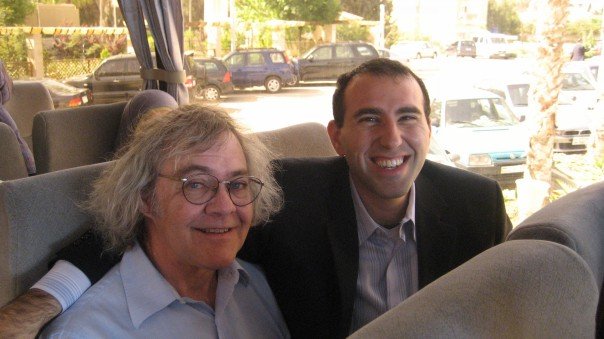
Ed and I later met and became friends. We once both went to Amman, Jordan, to give lectures to Jordanian journalists about the American First Amendment, journalism, and civil society. There is a picture of Ed and me in Jordan. I am sitting next to him on a bus with my arm around him as we are heading to the Dead Sea. We’re both smiling, but I’m smiling like a giddy little kid on his way to open Christmas presents. I wrote this caption to the picture when I posted it on Facebook: “C. Edwin Baker is one of my heroes. I got to hang out in Jordan eating lamb chops, seeing ruins, and chatting about the First Amendment with Ed. Most of the pictures are of ruins. But yes, I was this happy.”
And now I feel the opposite of that, about that sad. It’s a great loss.
I’ll miss calling him to discuss drafts of papers or recent policy initiatives. And I’ll miss looking forward to his next article or next book or to the next time he advises his friends in the public interest media advocacy community. (He was a hero to us all…) And I’ll miss seeing him for lunch in New York City, when I visit.
So, in short, like so many others who had the benefit of Ed’s generosity, kindness, honesty, genius, I’ll miss Ed Baker.
Note, Ed’s sister provided this comment:
A public Memorial Service for Ed Baker will be held on Jan. 31, at 2:00 pm in the Moot Court Room at Cardozo Law School of Yeshiva University (5th Ave. at 12th Street). There will be a reception in the lobby following the Memorial. His cremated remains will be buried privately at a later date in the Baker family plot in Madisonville, KY.
Net Neutrality, “TV Everywhere,” and Other Cable Industry Assaults on Open Television
As I wrote on Monday, this holiday season may finally be time for millions of Americans to cut the cord on cable TV and shift to watching TV over the Internet and over the the air.
Already, only half of your time in front of the TV involves cable channels–the other half comes from free over-the-air channels like ABC and CBS (which now broadcast in digital and high-definition) and from the Internet. With services like Netflix, Hulu, and iTunes, and some whiz-bang consumer electronics devices, supplementing that over-the-air TV with Internet TV is becoming easy and cheap–even if you want to watch the Internet on the flatscreen in your living room.
The CEO of Roku–a device that streams movies and shows from the Internet to your TV screens—has stated, “Our goal is to have everyone cancel their cable subscription.” And, today, with more people watching Hulu.com than watch many channels on cable TV, and with over-the-air TV providing high-definition channels, at least some people–if not everyone just yet–will cut the cord on cable.
While not everyone will “cut the cord” on cable, some will.
As a result, Internet TV could actually inject much-needed competition in a TV market long dominated by cable companies. Having more competitors in the game would lower prices, increase innovation, and create new job opportunities for entrepreneurs in the businesses they build. More importantly, with Americans watching Internet TV on their living-room TV television, TV becomes more democratic. Users would have more choice for speech and news. They could more easily share and tag video, and even produce their own channels without having to negotiate with and get a special deal from a cable operator. The cable operator would no longer be the gatekeeper of television.
Cable companies (of course) don’t want this threat of competition. The New York Times recently reported: cable companies “are trying to make sure people have a reason to keep paying hefty cable bills.”
Soon Comcast will be the first cable company to launch perhaps the industry’s boldest tactic yet in that fight, called TV Everywhere in the industry (which Comcast will market as Fancast Xfinity).
They won’t go down without a fight.
In fact, cable companies have spent many years fighting the emergence of Internet TV.
Let’s review the three previous tactics, all of which have resulted in consumer outrage, draft legislation, and/or Federal Communications Commission proceedings.
Cable companies have used their position as providers of Internet access to block (or threaten to block) technologies for online TV. Last year, the FCC had to order the largest cable company, Comcast, to stop blocking an Internet technology used by online TV distributors providing high-definition TV. The FCC concluded Comcast had an obvious anti-competitive motive. Since the early years of the Internet, cable companies would use their control of Internet access to discourage online TV. A cable CEO in 1999 declared he didn’t get into the cable business to “have the blood sucked out of the vein” by Internet TV. After several bills and some FCC enforcement proceedings, the FCC has moved towards adopting a rule.
2. Cap and metering.
While most Americans are used to paying a flat price for “all you can eat” Internet service, cable companies are experimenting with charging consumers based on consumption. Some usage-based pricing models might not always gouge consumers. But Time Warner Cable announced a trial of a pricing schedule that appeared targeted directly at people watching high-definition TV online. (You’d pay an arm and leg to watch Twilight!) Public outcry–which included draft legislation in the House and Chuck Schumer’s leadership in the Senate–delayed some trials, but the cable (and phone) companies continue testing this idea.
3. Control of cable set-top boxes.
A set-top box is the device sitting next to your TV which you connects your cable cord to the TV so you can watch cable channels on your TV. Chances are you rent this from your cable company at some non-competitively high price because of the lack of competition. In fact, there is no competitive market in set-top boxes. With competition, hundreds of consumer electronics companies could produce innovative boxes with cutting edge features. In addition, device makers like Apple and Roku or Tivo could integrate the cable TV offerings into one user-friendly interface, a point even the FCC has raised. (Imagine having to use your iPod only for digital downloads and to switch to a CD player for CDs; or imagine having to use the cable interface and to switch to an antenna to watch over the air television.) Congress has twice passed legislation requiring the FCC to ensure competition in set-top boxes. To its credit, the FCC has admitted its earlier, cable-friendly, attempts were a big big failure…
And now comes battle tactic number four, just in time for the holidays. And like the previous cable industry tactics, government officials should be concerned.
4. TV Everywhere.
TV Everywhere is a simple concept. Cable companies like Time Warner Cable and Comcast are making deals with their friends, the content companies like TBS and TNT, to lock up programming behind a wall. To get past this wall and watch the TBS, TNT (and most other) shows on the Internet … you have to be a cable subscriber. So, go ahead, try to cancel your cable TV bill. Try to watch TV online. Soon enough, unless you’re a cable subscriber, you’ll find you’ll have nothing to watch online. You can’t even buy an online-only subscription.
If you think TV Everywhere seems “anti-consumer” and “anti-technology”, you took the words right out the mouth of Disney’s CEO.
TV Everywhere is actually a pretty odd business concept.
It would be as though all the newspapers got together and decided that the only way to read newspapers online was to prove you were a home subsciber.
Or, it would be as though cable companies–competing with satellite TV–only let you watch TV shows on satellite TV if you were also a cable subscriber.
As an observor told Reuters: “It seems like a system designed to prevent the emergence of competitors.”
Exactly.
And it’s the latest tactic to keep competition at bay and maintain the cable companies’ control over your television.
As with tactics 1-3, TV Everywhere signifies the cable industry thrashing around to kill the biggest competitive threat they’ve ever faced–innovators on the Internet.
And as with tactics 1-3, the government has a role to promote competition and free speech, even at the expense of powerful special interests like Comcast and Time Warner Cable. The government should take that role seriously.
And as with tactics 1-3, consumers should make their voice heard.
The Holiday Season of Internet TV. Time to Cancel Your Cable Subscription
This holiday season is shaping up to be the season of Internet TV. Finally the time has come for Americans to watch TV through the Internet, and not just on laptop screens but on living room flat panel HD TV screens . Devices and services like AppleTV, Roku, Boxee, and Netflix let you watch popular movies and TV shows directly on your TV screen. To the delight of TV viewers but the annoyance of cable companies, it is time for many Americans to give themselves or loved ones a long-hoped-for gift. For them, it its time to cancel their ever-more-expensive cable subscriptions.
For decades, Americans have been forced to accept high prices and little choice for TV. This is because of limited competition–in most areas, just a local cable monopoly, satellite, and maybe the local phone company. But with an open Internet (and free over the air broadcasting), Americans can route around the cable gatekeepers and watch TV shows, films, and amateur video online. And technology and content companies can go straight to users.
Americans already watch TV over the Internet. Hulu.com airs shows from NBC, ABC, and Fox, and has over 40 million viewers a month, more than all of Time Warner’s channels, including CNN, TBS, and TNT. Through the Internet, you can watch BBC, CNN, and PBS. Services like Netflix‘s revolutionary service, Amazon VOD, iTunes, and the announced Sony Online are proliferating. Through Miro, an open sourced free application, you can watch hundreds of channels. You could also watch, or soon watch, Youtube, Vimeo, Babelgum, Rowdy Orbit, My Damn Channel, Funny Or Die, Vuze, and Roku box’s ten-channel service. and other outlets. (Hoping to get some recommendations in the comments…) And software like Boxee (which is free) can make all this easy and convenient.
Taking it one step further, Americans can watch any of these services on their television screens. Look at this Netflix page listing some of the devices supporting Netflix’s Internet delivery of movies and shows to your TV. Internet access is being built directly into Wi-Fi enabled flatscreen televisions from Vizio and Sony Bravia, BluRay players, gaming consoles like the Sony Playstation and Xbox, and online TV boxes like AppleTV and Roku.
Some of these devices and services are already in millions of family’s homes for other reasons–like video games and HD DVDs. Otherwise, they pay for themselves–if a customer cancels the monthly cable TV bill, that saves many hundreds of dollars each year. That comes in handy any time, not just holiday season.
This. Is. Awesome.
And it’s probably why more than one-in-three Americans is considering cutting the cord on cable TV in the next five years
But for cable companies like Comcast, Time Warner Cable, and Cox, this is … not awesome.
Cable companies would rather you not cancel your cable TV subscription and “that you pay them 70 bucks a month for maybe a lot of channels you don’t use.” And they are used to owning your living room television.
So cable companies are beginning to sour like the Grinch. The two largest cable companies, Comcast and Time Warner Cable, have been pressuring TV programming networks to keep their shows off the Internet.
Comcast’s COO told the New York Times that Comcast needs a model to protected its “core business,” so the Internet is not a “destroyer of wealth.” While NBC was renegotiating its carrier deal with Comcast, Hulu’s content partners (including NBC) asked Hulu to block access for Boxee users, as Boxee lets users watch Hulu on their TV screens.
In fact, the Comcast-NBC merger has been called “a defensive move to some extent by Comcast,” as “Comcast is eager to diversify its holdings amid an encroaching threat from online video” and other sources.
Time Warner Cable’s CEO has even said, “Guess what? We do mind,” that networks put their shows online for free; and if networks continue putting shows online “we have to intervene at some point.”
So consumers want their online TV. They want to watch shows through any device at any time, and are willing to pay for it. And innovative competition is beginning to meet that demand. Cable companies don’t want the competition. And they’ve had a questionable history in their dealings with online TV competition–including a major net neutrality violation.
Considering the cable companies’ reactions, policymakers in Washington should monitor the cable companies’ response to the threat of online TV. For the sake of millions of Americans this holiday season, policymakers should make sure online TV can compete fairly with cable TV. This way, thanks to DC, Americans could buy and use new TV services. And, if they wish, to cancel old ones and ring in the New Year cable-free.
Stories: Comcast-NBC’s Effect on Online TV and Net Neutrality
I spoke with the Washington Post about online television and a cable-industry initiative called TV Everywhere.
Indeed, Marvin Ammori, a media law professor at the University of Nebraska, warns that the TV Everywhere model could edge out small competitors who would provide alternatives to the cable subscription model. Ammori, an advisor to public interest group Free Press, said his group and others will urge regulators to closely scrutinize TV Everywhere’s impact on consumers and competition for new video companies.
“TV Everywhere is an effort by the old guard, the incumbent cable industry, to make sure change doesn’t come to the television,” Ammori said. “And their way of doing that is to make sure you can’t cancel your cable TV service and enjoy the dream of watching your favorite shows through new competitors like Hulu, Roku and Vuze.”
I also spoke with Wendy Davis at MediaPost about how the potential merger emphasizes the need for strong net neutrality rules.
The concern is that Comcast could use its status as the country’s largest Internet service provider to privilege its own online content, says Marvin Ammori, a University of Nebraska law school professor who advises Free Press. For example, Comcast could theoretically prioritize traffic to NBC.com at the expense of visits to other sites.
“This is yet another example of why we need a very firm and very strong net neutrality rule,” Ammori says.
Comcast-NBCU Merger is Bad for Democracy
For weeks, newspapers have reported in their business pages on a possible Comcast-NBC Universal merger (announced today), as a business story. The merger is more than a routine business story. The merger signifies massive media consolidation. This consolidation gives one company—Comcast—enormous control over the speech shaping Americans’ lives and shaping our democracy. The merger puts Comcast in control of MSNBC (a 24 hour news channel with an enormous impact on public opinion), CNBC (which impacts public opinion about Wall Street, now a hotly debated political question), NBC network (whose nightly news show averages eight million viewers, many times that of cable shows like those on Fox News), and 27 television stations (which generally have programs covering local news).
Putting so much power in the hands of one company—and, specifically, its executives—is dangerous for a democracy. There is a reason why autocratic regimes control the media—media shape public opinion and define what is “possible” in politics. We have seen the problem of private media consolidation in many countries. In Italy, Silvio Berlusconi used his massive media empire to win elections and is now Prime Minister (Italy’s longest serving ever). In Argentina, the government had to pass a media consolidation law because of the power of one media company that happens to be far smaller than a combined Comcast-NBCU.
How exactly is consolidation bad for democracy? Without being exhaustive, I’ll list three ways—targeted private censorship, structurally closing out independents, and favoring one-way communications.
First, consider private censorship. Big media companies can “censor” ideas they disagree with—they either don’t cover the censored ideas or cover them unfairly. You may remember what a poorly job the big media did with the run-up to the Iraq War. Specifically with Comcast, Comcast has censored important political ideas it disagreed with. For example, last year, cable and phone companies involved in the White House’s illegal, secret wiretapping program were lobbying for immunity from lawsuits. [Clarification, and note below: Comcast did not itself lobby on the wiretapping legislation.] While they lobbied to be above the law, some organizations took out advertisements criticizing the Congressmen collaborating with the phone and cable industry. One Congressman was a Democrat in Pennsylvania (Comcast’s home) Christopher Carney; that Congressman had taken lots of campaign money from Comcast and supported their immunity. While many media outlets ran an advertisement linking Carney and Comcast, Comcast refused. Comcast came up with excuse after excuse, and then simply didn’t run the ad. If Comcast had owned NBCU then, more outlets would have censored their advertisement—and people watching MSNBC, CNBC, NBC nightly news, and one of the 27 NBC stations would not have seen the ad on those outlets. Of course, a key goal of free speech would be frustrated–to ensure that the public can debate and be informed about the decisions of Congressmen. Keep in mind also that Comcast now owns MSNBC, the home of Keith Olbermann and Rachel Maddow, and is the company that paid people to sit at a government hearing (on net neutrality) and clap every time their executive spoke. We hope its newsmen don’t do the same. But here are the campaign contributions of the Comcast CEO, which are worth studying, as he may soon have even more political influence than he has today.
Second, this merger may make it harder for independent voices. When Comcast owns many TV networks, Comcast has incentives to favor the networks it owns and to carry them on cable TV. Put simply, independent cable TV networks have fewer slots to be carried, as Comcast will use channel slots on networks owned by Comcast. Already, independent networks argue that companies like Comcast discriminate against them and force the networks to give up some ownership of their company to be carried on cable. The biggest content companies—like NBC before—can force Comcast to carry their biggest channels and can force Comcast to carry some less popular channels as a price for carrying the big ones. So what happens in the end is a small independent network often has to sell itself to a Comcast or an NBC to get on cable TV and to survive. That is not a good outcome for Americans. Rather than having the option of cable channels owned by lots of different, independent groups, the speech is owned and controlled by a small club of companies. That club gets much smaller with a Comcast-NBCU merger. This club that would expand greatly if Comcast didn’t own TV networks.
Third, this merger favors one-way communications over open, two-way, “read-write” communications. As I mentioned, Comcast has an incentive to favor its own networks (for the economics/law geeks out there, see here and here). As a result, Comcast does not have an incentive to permit all forms of communication to flourish, but has incentives to favor its own programming, and to control other programming delivered over its cable TV and Internet access platforms. Comcast has less incentive to support wide open two-way communications available on an open Internet—which is why the FCC had to punish Comcast for blocking Miro and other BitTorrent applications on the Internet, finding also that Comcast had an anticompetitive incentive to block online TV technologies. It’s why Comcast has been spearheading something called TV Everywhere, which ties consumers’ ability to access online TV to payment for a Comcast cable TV subscription.
So, for three reasons, this merger is bad for democracy—private censorship, closing out independents, favoring one-way Comcast-controlled communications. It is not routine business. The public should take note of this affect on our democracy.
That is why organizations like Free Press and Media Access Project and Consumer Federation of America are working with allies in the StopBigMedia Coalition to oppose this merger (here’s a recent report).
It’s also why the Obama Administration, whose president campaigned on a promise to promote media diversity, and whose campaign inspired democratic participation, should stand with the public and likely block this merger.
Note: I added a clarification above that Comcast did not lobby on the wiretapping issue, according to their lobbying reports (which Comcast shared with me and are available here, here, here, here, and here). To have implied otherwise was a mistake. Comcast’s expressed problem with the proposed advertisement was that the ad was inaccurate by (a) implying Comcast lobbied for immunity and, apparently without evidence, that (b) Comcast would get a specific benefit from the specific bill at issue. I thank the folks at Comcast for calling me to discuss that point.
More broadly, the principle is correct–media companies have the legal power to engage in private censorship, which is an important potential source of power over our discourse. Moreover, stories of media companies altering reporting to benefit their own self interest are not uncommon (for some stories, see paragraphs 360-365 of even the controversial 2003 FCC Order relaxing broadcast ownership rules).
Comcast-NBC Merger
I have a lot of thoughts about the potential merger, which I hope to share when time permits. For now–I agree with people like Tim Wu and Josh Silver that the government should block the merger.
A Bloomberg story by Todd Shields, which I’ll share here, included a few of my thoughts.
In the News: U-Nebraska Law School Space & Telecom Program
Today, I figured I’d catalog some of the recent press hits for the UNL Space & Telecom Program, a program with which I am affiliated as a law professor at the U-Nebraska College of Law.
We had a stellar conference last week in DC, which resulted in at least six news stories.
Four of them were in the Washington Post and the Post online, and pertained to statements and ideas mentioned in a Keynote Conversation at our conference, on Thursday Nov. 19, between Andrew McLaughlin of the White House and Tim Wu of Columbia Law School. Numbers 2 and 3 mention the conference by name: (1, 2, 3, and 4).
The Hill covered the keynote opening address by Alec Ross, of the State Department.
I wrote a Huffington Post story about an issue in these stories.
Broadband Census also covered the conference.
Outside the conference, this month, my thoughts were featured both in the Post (about set top boxes) and the Hill (on online shopping and policy).
CyberMonday Shopping: Celebrate Net Neutrality
Apparently, the first Monday after Black Friday is a big online shopping day, as Americans go back to work … and shop online. Whether CyberMonday is hype or not for retailers, it’s a good day to celebrate Internet openness.
For years, a debate has raged in DC over whether phone and cable companies should be allowed to block, discriminate against, or otherwise interfere with users’ access to everything online. The millions of people and hundreds of groups favoring Internet openness advocate for a network neutrality law, ensuring this openness. Many favor net neutrality because of free speech concerns.
But let’s not forget that an open Internet supports American business. Any company, or person, can sell any products online without permission. Any person can go to any site–not one with a special deal with the phone or cable company–to buy any gift for any loved one.
It’s for business reasons that net neutrality proponents include Amazon, EBay, Sony, Google, and Expedia. It’s why top venture capitalists argue that, in the 21st Century, investment in new businesses and entrepreneurs–and therefore job growth–rests on net neutrality.
So enjoy the open Internet today–and maybe interrupt your CyberMonday shopping for a moment of work for net neutrality–whatever your day job…
Network Neutrality Advances Our Foreign Policy, Promotes Democracy
Last week, the University of Nebraska-Lincoln College of Law’s Space & Telecomm Program organized a conference in DC.
Discussions at the conference about free speech, diplomacy, and foreign policy have resulted in quite a bit of press. Government speakers mentioned the obvious: that if we don’t protect Internet freedom at home–from public or private gatekeepers–then we undermine our strength abroad in arguing for Internet freedom and for citizens’ increased access to participatory technology tools.
The Hill and Washington Post reported on some statements at the conference, and the Post covered the follow-up debates.
I wrote a post at the Huffington Post about the principle of network neutrality and its influence on our diplomacy and foreign policy objectives.
In addition to prompting this healthy public discussion, we at UNL were fortunate to have an exceptional lineup of influential speakers over two days and were excited that our LLM students could join us–and that an alum, who is now a legal advisor in the U.S. Air Force JAG on cyberwarfare law, was able to present.
 Marvin Ammori